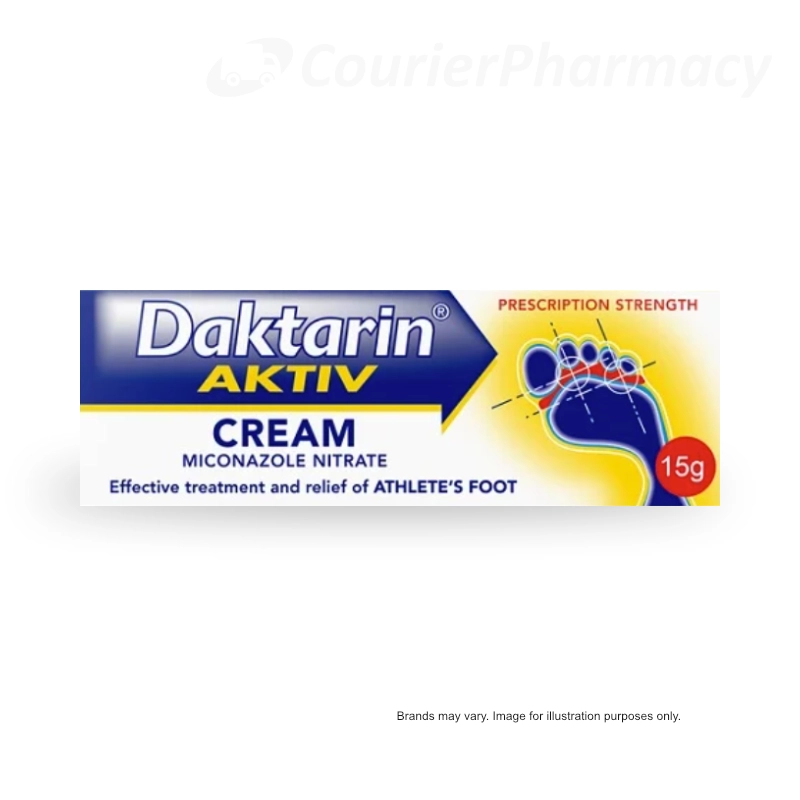
Daktarin Aktiv Cream contains miconazole nitrate 2%. This is the same active ingredient as Daktarin Cream. However, it comes in a foot-care branded product, so it’s often chosen for athlete’s foot and similar fungal skin infections.
It comes as a 15g tube and it also, it sits in the Daktarin Aktiv foot-care range alongside Daktarin Aktiv Powder.
What makes Daktarin Aktiv Cream different?
Daktarin Aktiv Cream stands out because it offers:
The same active ingredient as Daktarin Cream (miconazole nitrate 2%)
A foot-care focus, so it’s aimed at athlete’s foot
A cream format, which you rub into dry or scaly skin
A match with Aktiv Powder, so you can choose the best format for the area
An imidazole antifungal, which works against a wide range of fungi
Cream vs powder: which format suits which symptoms?
The active ingredient is the same in both formats. Even so, the vehicle (cream or powder) matters because different skin types need different delivery.
When cream is usually the better choice
Cream format often suits:
Dry, scaly skin, because it stays in contact with the skin for longer
Moccasin-type athlete’s foot, which affects the soles and sides of the feet
Body ringworm, which can cause round, scaly patches on the body
Jock itch (tinea cruris), especially when the skin is dry and irritated
Small, localised patches, where you want targeted rub-in treatment
When powder is usually the better choice
Powder format often suits:
Moist areas, such as between the toes or in skin folds
Sweaty feet, because it can help absorb moisture as well
Shoes and socks, because you can dust it into footwear
Prevention, as a light daily routine after treatment (if appropriate)
Using cream and powder together (often works best)
Athlete’s foot can be mixed. For example, you might have dry skin on the soles but moisture between the toes. In that case, using both formats can help.
A common approach is:
Cream on dry, scaly soles and sides
Powder between toes and in footwear
Lifestyle steps alongside both (like drying well and changing socks)
As a result, this combined approach can be more effective than relying on just one format.
Moccasin-type athlete’s foot: what to know
Moccasin-type athlete’s foot is easy to miss because it does not always look like “classic” athlete’s foot.
It is often:
Slow to develop
Dry and scaly (and sometimes thickened)
Mainly on the soles and sides of the feet
Mistaken for dry skin or eczema
On both feet
Less itchy than the between-the-toes type
Linked to thickened skin (hyperkeratosis)
Often caused by Trichophyton rubrum
Why it can be harder to treat
This type can be stubborn because:
The skin can be thicker, so treatment may not reach as well
Fungi can sit deeper in the skin layers
Powder may not work well on thick, dry skin
Treatment may need longer (often 6–8 weeks)
It can come back if the skin stays warm and damp
Because of that, a cream format can be a better fit for this presentation.
Who might choose Daktarin Aktiv Cream?
Daktarin Aktiv Cream may suit:
People with dry, scaly athlete’s foot, including moccasin-type
People with body ringworm
People with jock itch, especially where cream feels more comfortable
Anyone who prefers a cream over a powder
People using the Daktarin Aktiv range, especially alongside Aktiv Powder
Active people who want a foot-care focused option
How it compares with other antifungal options
Here’s how it sits next to common alternatives:
Vs Daktarin Aktiv Powder: same active ingredient, but powder suits moist areas while cream suits dry areas
Vs Daktarin Cream (non-Aktiv): same active ingredient and effect, but different branding
Vs Daktarin Powder (non-Aktiv): same active ingredient, different format
Vs Canesten Cream (clotrimazole): similar type of antifungal, but a different active ingredient
Vs Lamisil AT Cream (terbinafine): different class, and courses can be shorter for some cases
Vs antifungal + steroid creams (e.g., Daktacort): includes an anti-inflammatory, which may help when skin is very inflamed (not for everyone)
Vs oral antifungals: used for severe, widespread, or resistant infections (needs clinical review)
Pharmacist review at Courier Pharmacy
At Courier Pharmacy, every Daktarin Aktiv Cream supply is reviewed by a UK pharmacist. So, we can talk through your symptoms and help you choose whether cream, powder, or both makes the most sense.
Features and specifications
Active ingredient: miconazole nitrate 2%
Form: white cream
Pack size: 15g tube
Brand range: Daktarin Aktiv (foot-care range)
Class: topical imidazole antifungal
Legal status: Pharmacy (P) medicine in the UK
Age range: adults and children (ask a pharmacist for young children)
Typical use: twice daily for 4–6 weeks
Storage: room temperature
Additional information
Quantity
1 x 15g, 2 x 15g, 3 x 15g
MOJO WISDOM
Take control of your health by understanding your condition and what this medication is doing for you.
READ:
More information about this treatment.
UK-based doctors and pharmacists
Discreet and Confidential
UK-based doctors and pharmacists
Free, Expert Advice
No video link provided.
No video link provided.
UK-based doctors and pharmacists
Free, expert advice
Discrete and confidential
Fast delivery
Giving you trusted clinical advice for over 40 conditions
A UK regulated pharmacy providing safe, effective treatments online since 2014
Athlete’s foot that’s left your soles dry and scaly rather than (or as well as) the classic between-toes maceration, the patches of thickened skin on the sides of your feet that have crept up over months, the ringworm patch on your trunk that you’ve finally identified as fungal rather than eczema.
Maybe a powder is fine for between the toes but you need something that gives sustained contact on dry scaly skin. Maybe you’ve used Daktarin cream before for fungal skin infections and want the foot-care branded version. Maybe you’ve been using Daktarin Aktiv Powder for treatment and prevention but also need a cream for the dry areas.
Daktarin Aktiv Cream contains miconazole nitrate 2% — the same active as Daktarin Powder, Daktarin Cream, and Daktarin Aktiv Powder — in a cream format positioned for foot care. The cream sustains skin contact better than powder on dry areas and rubs into hyperkeratotic skin where powder would simply sit on the surface. At Courier Pharmacy we want to explain the cream vs powder format choice, where Daktarin Aktiv Cream fits alongside the Aktiv Powder, and how to combine the two formats for comprehensive foot care.
Five key takeaways
Daktarin Aktiv Cream contains miconazole nitrate 2% — identical active ingredient to Daktarin Cream, Daktarin Powder, and Daktarin Aktiv Powder — in a foot-care branded cream format. Standard pack: 15g tube. Pharmacologically interchangeable with Daktarin Cream; the differentiation is in branding and positioning for foot-care use specifically.
Cream vs powder format choice: cream suits dry, scaly, hyperkeratotic skin where sustained contact and rub-in delivery matter (soles, sides of feet, moccasin-type athlete’s foot, body ringworm). Powder suits moist areas (between toes, skin folds) and works well dusted into shoes and socks. Many people benefit from having both available — cream for the scaly dry areas, powder for between toes and footwear.
Standard regimen: apply twice daily to the affected area; continue until symptoms clear, then continue for a further 10 days; total course typically 4-6 weeks for athlete’s foot. Same as standard Daktarin Cream — the Aktiv branding doesn’t change the antifungal pharmacology or course requirements.
Particularly suited to moccasin-type athlete’s foot: the chronic, dry, scaly, hyperkeratotic presentation that affects soles and sides of feet (in contrast to the moist interdigital type). Cream’s sustained contact with thickened skin gives better penetration than powder. Combined with daily emollient between antifungal applications, the moccasin presentation usually clears with patience over 6-8 weeks.
For comprehensive foot care in active people prone to athlete’s foot, the Daktarin Aktiv pair (cream + powder) provides format coverage for all the different presentations. Cream on dry areas; powder between toes and in footwear. For shorter active treatment of interdigital athlete’s foot specifically, Lamisil AT (terbinafine, 7-day course) is an alternative with different mechanism and shorter duration.
Treatment dosage Daktarin Aktiv Cream
The cream is used for treatment of active fungal skin infections.
Additionally, standard adult and child dosing for athlete’s foot and body fungal infections:
Apply twice daily to the affected area
Continue until symptoms clear
Then continue for a further 10 days
Total course typically 4-6 weeks for athlete’s foot
Moccasin-type athlete’s foot may need 6-8 weeks
Application technique:
Wash and thoroughly dry the affected area
Squeeze a small amount of cream onto your finger
Apply a thin layer to the affected skin
Rub in gently until absorbed
Apply slightly beyond the visible affected area
Wash hands afterwards (unless treating hands)
Don’t cover with occlusive dressings unless directed
Frequency:
Twice daily
Morning and evening typically
Don’t exceed 4 applications per day
Consistent twice-daily application matters more than frequency
Practical tips:
Apply to dry skin: more effective absorption than into wet skin
Rub in thoroughly: especially on hyperkeratotic (thickened) areas
Pregnancy and breastfeeding: topical miconazole is generally considered safe
Children: generally safe; consult pharmacist for young children
For example, don’t use Daktarin Aktiv Cream if:
You have known hypersensitivity to miconazole or other imidazole antifungals
You have known hypersensitivity to any excipient
You have a confirmed bacterial infection requiring different treatment
You have severe skin breakdown of unknown cause
You have a fungal nail infection alone (won’t penetrate effectively)
Use with care if:
You are pregnant or breastfeeding (generally safe but discuss)
You have diabetes (skin integrity considerations)
You have peripheral vascular disease
You are immunocompromised
You are on warfarin (theoretical interaction with extensive topical use)
The infection covers a large area
When to seek medical advice:
No improvement after 4 weeks of consistent treatment use (or 6-8 weeks for moccasin type)
Worsening symptoms despite treatment
Signs of bacterial superinfection (yellow discharge, increased pain, fever)
Spreading infection
Nail involvement
Diabetic patients with significant skin issues
Recurrent infection despite full courses
Overview of Daktarin Aktiv Cream
Five things worth knowing:
Cream is the right format for dry, scaly skin. Where powder simply sits on the surface of thickened skin, cream rubs in and gives sustained contact. For moccasin-type athlete’s foot (chronic dry scaly soles), body ringworm, and jock itch in less moist groin folds, cream substantially outperforms powder.
The combined cream-plus-powder approach addresses mixed presentations. Real-world athlete’s foot often has both maceration between toes AND dry scaly soles. Treating each area with the appropriate format gives better outcomes than one format alone. Daktarin Aktiv Cream + Daktarin Aktiv Powder is the natural pairing.
Moccasin-type athlete’s foot needs patience. The chronic dry scaly presentation has fungal organisms deep in thickened skin. Treatment courses of 6-8 weeks are normal, with emollient between antifungal applications helping to soften the thickened skin and improve penetration. Don’t stop at 4 weeks for moccasin-type just because the dry skin appearance hasn’t transformed.
The Aktiv branding doesn’t change the pharmacology. Same active (miconazole nitrate 2%), same mechanism, same course requirements as standard Daktarin Cream. The Aktiv brand line is about positioning for foot care, not a different drug.
For shorter active treatment of interdigital (between-toes) athlete’s foot, Lamisil AT (terbinafine) has the 7-day-course advantage. For moccasin-type, body ringworm, jock itch, or where the broader licensed indications matter, Daktarin (any format) is generally preferred.
The athlete’s foot presentation landscape:
Interdigital type: most common; moist macerated skin between toes; itching; sometimes burning. Powder format ideal; treatment usually 4-6 weeks.
Moccasin type: chronic; dry scaly thickened sole skin; less itching; often missed. Cream format ideal; treatment 6-8 weeks; emollient helpful.
Vesicular type: blisters on instep and arch; more inflammatory; less common. Cream and consideration of combined steroid-antifungal product.
Ulcerative type: severe; bacterial superinfection; needs combined treatment. GP referral.
Daktarin Aktiv Cream’s principal value is in the moccasin type and mixed presentations.
Why choose Courier Pharmacy for Daktarin Aktiv Cream
Different fungal skin presentations need different format choices. In particular, every Daktarin Aktiv Cream supply at Courier Pharmacy is reviewed by a UK pharmacist who can help match the format to the presentation.
In short, we’ll discuss whether cream is the right format. Dry scaly skin, moccasin-type athlete’s foot, body ringworm, jock itch: yes. Similarly, wet macerated between toes: powder may suit better.
We’ll cover the moccasin type. Indeed, this presentation is often missed or undertreated; the longer course and emollient combination matter.
We’ll talk about combining formats. Cream on dry areas, Daktarin Aktiv Powder between toes and in footwear — comprehensive coverage for mixed presentations.
We’ll discuss alternatives. As a result, lamisil AT Cream and Gel for shorter courses; Canesten for clotrimazole preference; Daktacort for inflamed presentations needing combined steroid-antifungal.
Generally, we’ll cover course discipline. 10 days beyond symptom clearance for any presentation; 6-8 weeks total for moccosin type.
We’ll discuss when to escalate. Severe, extensive, resistant, or nail-involved infections may need oral antifungal or GP review.
In addition, our brand guide, Dr Ada Jex-Cori, sums it up: you’re not broken. Additionally, the system that’s failed you might be. We want to do the part we can do, properly, and connect you with the rest. For example, that includes our free fortnightly drop-in clinics and talks at Insomnia in Derby, where you can ask questions face-to-face without spending a penny.
Buy Daktarin Aktiv Cream from Courier Pharmacy
Daktarin Aktiv Cream is available as a pharmacy (P) medicine in the UK. Importantly, buying through Courier Pharmacy is straightforward and includes pharmacist review.
Here’s how it works:
Complete a quick online consultation about the fungal skin infection
A UK pharmacist prescriber reviews your information
If suitable, supply is approved
We dispense and deliver discreetly to your door
On the other hand, if it isn’t suitable for you, we’ll explain why and suggest the next best option.
Active Ingredients
Importantly, the active ingredient is miconazole nitrate 2% — identical to Daktarin Cream, Daktarin Powder, and Daktarin Aktiv Powder. On the other hand, for full mechanism detail, see our Daktarin Powder for Athlete's Foot description.
Brief summary:
Class: imidazole antifungal
Mechanism: inhibition of fungal cytochrome P450 14-alpha demethylase, disrupting ergosterol synthesis and fungal cell membrane integrity
Spectrum: dermatophytes (Trichophyton, Microsporum, Epidermophyton), yeasts (Candida), some gram-positive bacteria
Action: fungistatic at low concentrations; fungicidal at higher concentrations
Topical pharmacokinetics: minimal systemic absorption from cream; persists in stratum corneum
Safety: well-tolerated topically; safe across age ranges; safe in pregnancy and breastfeeding
Cream-specific characteristics:
Sustained skin contact — cream sits on skin longer than powder
Rubs into dry/thickened skin — better penetration of moccasin presentations
Less moisture absorption than powder — not ideal for actively wet areas
Aesthetic — invisible once rubbed in; clothing-friendly
Other excipients in Daktarin Aktiv Cream include cream base ingredients (typically polyethylene glycol, polyethylene glycol stearate, butylhydroxyanisole, octyldodecanol, benzoic acid, purified water). Therefore, specific excipients are on the patient information leaflet.
What is it for?
Consequently, daktarin Aktiv Cream is used for:
Athlete's foot — particularly moccasin-type (dry scaly sole presentation)
Body ringworm (tinea corporis) — circular scaly patches
Jock itch (tinea cruris) — groin and inner thigh involvement
Other fungal skin infections — same uses as Daktarin Cream
Candida skin infections in skin folds where cream contact is helpful
It's appropriate for:
Adults and children with topical fungal skin infections
Use on dry, scaly, thickened skin
Body fungal infections
Localised lesions with defined edges
Combined with Daktarin Aktiv Powder for comprehensive foot care
Daktarin Aktiv Cream is not appropriate for:
Fungal nail infections (won't penetrate)
Scalp fungal infections (use specific scalp products)
Severe or extensive fungal infections (may need oral treatment)
Bacterial infections requiring different treatment
Heavily macerated wet skin (powder may suit better)
How does it work?
However, the mechanism is the same as other miconazole products — see our Daktarin Powder for Athlete's Foot description for detailed time course. Briefly:
Imidazole antifungal acts on fungal ergosterol synthesis
Disrupts fungal cell membrane
Fungistatic to fungicidal action over treatment course
Cream format provides sustained skin contact and penetration into dry/thickened skin
Time course:
Day 1-3: cream applied twice daily; antifungal action begins
Week 1-2: symptoms begin improving; itching settles; redness reduces
Week 2-4: continued application; fungal load decreasing; healing progressing
Week 4-6: course continues 10 days beyond symptom clearance to prevent recurrence
For moccasin type: 6-8 week course with continued emollient use beyond
What it doesn't do:
Doesn't work on nails (won't penetrate)
Doesn't immediately resolve infection
Doesn't substitute for good foot hygiene
Doesn't address bacterial superinfection
Doesn't work as well as powder on actively wet/macerated skin
Doesn't replace medical assessment for severe or resistant infections
How to use it
Standard technique:
Wash the affected area with mild soap and warm water
Thoroughly dry — pat dry rather than rubbing aggressively
Squeeze a small amount of cream onto your finger
Apply a thin layer to the affected skin
Rub in gently — particularly important on dry thickened areas
Apply slightly beyond visible affected area
Allow to absorb before dressing
Wash hands afterwards
For moccasin-type athlete's foot:
Apply twice daily as standard
Between applications, use an emollient (E45, Diprobase, Doublebase) to soften thickened skin
Course 6-8 weeks rather than 4-6
Patience needed; visible improvement slow
For body ringworm:
Apply to entire affected ring plus 1cm margin
Twice daily
Continue 2 weeks after lesion clears
For jock itch:
Apply to affected area in groin/inner thigh
Continue 2-4 weeks
Keep area dry between applications
Practical tips:
Two formats combined: cream on dry areas, Daktarin Aktiv Powder between toes and in footwear
Known hypersensitivity to miconazole or other imidazoles
Known hypersensitivity to any excipient
Severe skin breakdown of unknown cause
Use with care if:
Pregnancy (generally safe but discuss)
Breastfeeding (don't apply to breasts directly)
Diabetes (skin integrity)
On warfarin with extensive topical use
Immunocompromised
Large affected area
Pregnancy:
Generally considered safe
Minimal systemic absorption
Use sensible amount; avoid extensive application
Breastfeeding:
Generally safe
Don't apply to breasts while breastfeeding
Minimal systemic exposure
Children:
Generally safe for use
Consult pharmacist for young children
Drug interactions:
Warfarin: theoretical concern with extensive topical use
Oral antifungals: don't combine without medical advice
Most prescribed medications: no important interactions through topical pathways
Allergic reactions:
Allergic contact dermatitis possible but uncommon
Stop and reassess if reaction develops
In summary, if you experience a worsening reaction or signs of significant allergy, stop using and seek medical advice.
Side Effects
Topical miconazole cream is well-tolerated.
Overall, common side effects, between 1 in 100 and 1 in 10 people, include mild local irritation at application site, mild burning sensation initially, and mild skin redness.
Uncommon side effects, between 1 in 1,000 and 1 in 100 people, include contact dermatitis, itching at application site, and dryness or peeling.
Notably, rare side effects, fewer than 1 in 1,000 people, include severe allergic skin reactions, blistering, and significant inflammation requiring discontinuation.
Furthermore, very rare and serious side effects include severe hypersensitivity reactions (very rare with topical use).
If you experience any side effect that worries you, you can report it directly to the MHRA's Yellow Card scheme. Specifically, this helps improve safety data for everyone who uses the product. Our pharmacy team are happy to help you submit a Yellow Card report if you'd like assistance.
Drug Interactions
Meanwhile, topical miconazole cream has few clinically important drug interactions.
Considerations:
Warfarin: theoretical concern with extensive topical use; oral miconazole has clear warfarin interaction
Oral antifungals: don't combine for the same indication
Other topical products on same skin area: usually no significant interaction; space applications
In fact, tell your pharmacist about all medicines you take when starting any new treatment.
Frequently Asked Questions
What is Daktarin Aktiv Cream used for?
Treatment of athlete's foot, body ringworm, jock itch, and other fungal skin infections. Particularly suited to dry, scaly presentations. Contains miconazole nitrate 2%.
How is it different from Daktarin Cream?
Same active ingredient. Therefore, daktarin Aktiv Cream is positioned within the foot-care branded sub-range; standard Daktarin Cream is the broader OTC product. Pharmacologically interchangeable.
How is it different from Daktarin Aktiv Powder?
Same active; different format. Consequently, cream suits dry, scaly skin (soles, body); powder suits moist areas (between toes, skin folds) and footwear treatment.
Which should I use — cream or powder?
Depends on the presentation. Between-toes maceration: powder. Dry scaly soles, body ringworm, jock itch: cream. However, mixed: both, used on different areas.
How does it work?
Moreover, miconazole inhibits an enzyme essential for fungal cell membrane synthesis. See our Daktarin Powder for Athlete's Foot description for fuller mechanism detail.
How long do I need to use it?
In summary, 4-6 weeks for typical athlete's foot. 6-8 weeks for moccasin-type. Overall, continue 10 days after symptoms clear.
What about moccasin-type athlete's foot?
This dry scaly sole presentation needs the cream format and a longer course (6-8 weeks). Notably, combine with emollient between antifungal applications to help soften thickened skin.
Can I use it for body ringworm?
Furthermore, yes — apply to the entire ring plus 1cm margin twice daily. Continue 2 weeks after the lesion clears.
Can I use it for jock itch?
Specifically, yes — cream works well in the groin area.
What's the difference from Lamisil AT?
Meanwhile, lamisil AT contains terbinafine (different class — allylamine). Lamisil's course is shorter (1-2 weeks for athlete's foot). Daktarin has broader licensed indications.
Can I use it in pregnancy?
Generally yes — topical miconazole has minimal systemic absorption.
Can I use it while breastfeeding?
In fact, yes — don't apply to breasts directly.
Can children use it?
Yes — generally safe. Consult pharmacist for young children.
Can I combine cream and powder?
Yes — and it's often a good approach for mixed presentations. In particular, cream on dry scaly soles and other dry areas; Daktarin Aktiv Powder between toes and dusted into footwear.
Should I use emollient with it?
In short, for moccasin-type athlete's foot, yes — emollient between antifungal applications helps soften thickened skin.
Can I use it with hydrocortisone?
Daktacort is a purpose-made combined product (miconazole + hydrocortisone). Similarly, don't mix products randomly; if you need anti-inflammatory action, discuss with pharmacist.
What about my fungal toenails?
Topical cream won't penetrate nails. Indeed, for nail fungus, use a specific topical lacquer (amorolfine/Curanail) or oral terbinafine (specialist prescription).
What if it keeps coming back?
Recurrence is common. Address underlying causes: hygiene, footwear, hyperhidrosis, household contacts. As a result, consider GP review for persistent issues.
Can I use it on my face?
Generally not recommended without medical advice. Generally, face fungal infections need careful diagnosis.
What if I have diabetes?
Athlete's foot in diabetes needs particular attention. In addition, consult pharmacist; foot care is part of broader diabetes management.
How should I store it?
Room temperature; protect from heat. Replace cap after use.
Disclaimer: This information is for education only and isn’t a substitute for personal medical advice. Always follow your prescriber’s instructions.
References
Medicines.org.uk (emc). (n.d.) Daktarin Aktiv Cream 2% w/w Cream: Summary of Product Characteristics (SmPC). Datapharm. Available at: https://www.medicines.org.uk/emc/ (Accessed: 11 July 2026).