

Find the right eyebrow hair growth for you
View All Products


What you should know about eyebrow hair loss
There are many possible reasons, from years of plucking to ageing, hormones, skin conditions, low iron, or a thyroid problem. As Cleveland Clinic explains, the pattern often hints at the cause. Because some causes are easily treatable, it’s worth getting new or unexplained eyebrow thinning checked rather than assuming it’s permanent.
It can. Loss of the outer third of the eyebrows, the part nearest your ears, is classically linked to an underactive thyroid, as a 2023 report in QJM describes. It isn’t proof on its own, but if you also feel tired, gain weight, or feel the cold, a thyroid blood test is worth doing. Courier Pharmacy can arrange one.
Yes, the evidence is encouraging. Randomised studies show topical minoxidil 2% safely improves eyebrow thickness and hair count, and one trial found it as effective as bimatoprost. We offer it as a freshly compounded 2% cream, applied twice a day, which stays put better than a scalp solution. It’s used off-label for brows, so it’s supplied after a pharmacist assessment.
Apply a small amount to clean, dry eyebrows twice a day, morning and evening, using a clean fingertip or cotton bud. Keep it away from your eyes and broken skin, and wash your hands afterwards. Because it’s freshly compounded, each pot has a 30-day shelf life, so you start a fresh one monthly. Consistency matters more than quantity.
Because brows aren’t scalps. Scalp liquids and foams are designed to spread, which is exactly what you don’t want near your eyes. A cream stays where you put it, giving far better control over a small, delicate area. Compounding also lets us make it fresh at the right strength and leave out ingredients that irritate thin brow skin.
Eyebrows grow slowly, so patience is essential. Most studies run for around 16 weeks before judging results, and many people need several months of consistent twice-daily use. If you stop, any gains tend to fade, so treatment usually needs to continue to maintain the effect.
Often, yes, but not always. Giving over-plucked brows a long rest can allow follicles to recover, though years of plucking can leave some follicles permanently inactive. If regrowth is slow or patchy, our compounded minoxidil 2% cream may help support it.
Often, yes. We can review what you’ve tried, check for underlying causes with blood tests including thyroid and iron, use TrichoTest to personalise your plan, and offer our compounded minoxidil 2% cream. It starts with a free chat with one of our pharmacists.
Additional information
Eyebrow hair growth
Eyebrow hair growth is something most of us never think about, right up until our brows start looking sparser than they used to. Whether it’s years of plucking, ageing, or something going on under the surface, thinning eyebrows are common and often very treatable. At Courier Pharmacy, we believe healthcare should fit the person, not force the person to fit the system. So we build support around your brows and your biology, with treatment tailored to you, including our freshly compounded minoxidil 2% cream, honest guidance from real pharmacists, a community that gets it, and care you can trust. Hair loss treatment that fits you, brows included. Eyebrows looking thinner than they used to? We can help you support healthy eyebrow hair growth.

Five key takeaways
- Eyebrow thinning is common and usually treatable. As the dermatology literature notes, it can come from grooming habits, ageing, hormones, or an underlying condition.
- The pattern is a clue. Loss of the outer third of the eyebrow, known as the Queen Anne or Hertoghe sign, is classically linked to an underactive thyroid, as a 2023 case report in QJM describes.
- Minoxidil can help. Randomised studies show topical minoxidil 2% safely improves eyebrow thickness and count, which is why we offer it as a cream.
- It’s worth checking for treatable causes like thyroid problems or low iron before assuming it’s permanent.
- Patience matters. Like scalp hair, brows grow slowly, so most treatments need several months before you can judge them.

What Courier Pharmacy offers for eyebrow hair growth
- Compounded minoxidil 2% cream, freshly made with a 30-day shelf life, applied twice daily
- Blood tests to check for underlying causes, including thyroid function and iron levels
- TrichoTest, a pharmacogenetic test that helps personalise your hair plan
- Compounded, tailored formulations where standard products don’t suit
- Free pharmacist consultations to build a routine that works for you
- Free fortnightly drop-in clinics in Derby, with no cost and no pressure

What you should know about eyebrow hair growth treatments
Good eyebrow care follows a simple, sensible path. First, work out why your brows are thinning, because the cause shapes everything. Second, treat anything reversible, like a thyroid problem or low iron. Third, use treatments that genuinely have evidence behind them, such as topical minoxidil. Fourth, tailor that plan to you and give it time to work.
This is the approach we lean on at Courier Pharmacy. As the dermatology literature notes, there’s no single licensed treatment for poor eyebrow hair growth, so a personalised plan really matters. The goal isn’t perfection. It’s brows you’re happy with, and peace of mind that nothing treatable has been missed.
Eyebrow hair growth overview
Eyebrows do more than frame your face. As the eyebrow research literature notes, they shield your eyes from sweat and debris and play a big role in expression and identity. So when they thin, the impact is rarely just cosmetic.
Thinning brows, known medically as eyebrow hypotrichosis or madarosis, are surprisingly common. Cleveland Clinic describes madarosis as loss of the eyebrows or eyelashes, and stresses it’s a symptom rather than a disease in itself. That distinction matters because it points to a cause worth finding.
The good news is that eyebrow hair growth can often be supported, whether by treating an underlying issue, using an evidence-based topical like minoxidil, or both. As the comparative trial by Zaky and colleagues found, topical treatments can meaningfully improve eyebrow density. The key is matching the approach to the reason your brows thinned in the first place.
Why does this matter? Because sparse brows can knock confidence, and many people assume nothing can be done. Often, something can. A proper look at the cause is the first and most valuable step.
What affects eyebrow hair growth?
Eyebrow hair grows in a cycle, much like the hair on your head, but with a shorter growing phase, which is why brows stay relatively short. Anything that disrupts that cycle can lead to thinning. As Cleveland Clinic explains, the pattern of loss often hints at the cause.
Signs worth noticing include:
- General thinning across one or both brows
- Loss focused on the outer third, nearest your ears
- Patchy bald spots within the brow
- Brows that have never fully grown back after years of plucking
- Thinning alongside changes to your scalp hair or eyelashes
- Itchy, flaky, or irritated skin in the brow area

When eyebrow loss is a clue: the outer third and your thyroid
Here’s something many people don’t know. If the outer third of your eyebrow, the part nearest your ears, is thinning or disappearing, it can be a sign of an underactive thyroid. Doctors call this the Queen Anne sign or the Hertoghe sign, and it’s been recognised for over a century.
As a 2023 case report in QJM explains, loss of the outer third of the eyebrows is a recognised feature of hypothyroidism, particularly when it’s long-standing or untreated. It happens because low thyroid hormone disrupts the hair growth cycle. Importantly, the sign isn’t proof on its own. As clinical reviews note, it can also appear with ageing, eczema, and other conditions, and plenty of people with thyroid problems never get it.
So treat it as a prompt, not a diagnosis. If your outer brows are thinning and you also have symptoms like tiredness, weight gain, feeling the cold, or dry skin, it’s well worth checking your thyroid. As NICE Clinical Knowledge Summaries advise, this is done with a simple blood test. This is one area where Courier Pharmacy can help directly, arranging thyroid and other blood tests so nothing treatable gets missed. Courier Pharmacy offer an Advanced Home Thyroid blood test, which measures TSH (thyroid-stimulating hormone), FT4 (free thyroxine), FT3 (free triiodothyronine), thyroid antibodies TPOAb (thyroid peroxidase antibodies) and TgAb (thyroglobulin antibodies) and total bilirubin. The encouraging part is that once a thyroid problem is treated, brows often recover, though regrowth can be slow.
How common is eyebrow thinning?
Eyebrow thinning is far more common than people realise, partly because so many of us quietly cause some of it. Decades of plucking, threading, and waxing take a toll, and as the dermatology literature notes, repeated grooming is one of the most frequent reasons brows don’t grow back fully.
It also rises with age and hormonal change, and it’s a feature of several common conditions. Research suggests thyroid problems alone affect a large share of people with eyebrow loss, with some studies linking hair changes to up to half of those with an underactive thyroid. In short, if your brows have thinned, you’re in good company, and there’s usually a reason worth identifying before you write off your eyebrow hair growth.
What causes eyebrow thinning?
There’s often more than one cause at play. Eyebrow thinning can stem from habits, hormones, skin conditions, and general health. Cleveland Clinic and the wider dermatology literature describe the main culprits.
Over-plucking and grooming
This is one of the commonest causes. Years of plucking, waxing, threading, or tinting can damage follicles, and as the literature notes, some simply stop producing hair. Caught early, giving brows a long rest can help.
Ageing and hormones
Hair naturally thins with age, and hormonal shifts, including around the menopause, can affect the brows as well as the scalp. This kind of gradual thinning is very common.
Thyroid disorders
Both underactive and overactive thyroid can cause hair loss, with the outer-third pattern classically linked to hypothyroidism, as described above. Treating the thyroid often improves things.
Autoimmune conditions
In alopecia areata, the immune system attacks hair follicles, which can cause patchy brow loss. Frontal fibrosing alopecia, more common after the menopause, often affects the eyebrows noticeably and needs specialist input.
Skin conditions
Eczema, psoriasis, and seborrhoeic dermatitis around the brows can disrupt the follicles and lead to thinning. Treating the skin can help the hair.
Nutritional deficiencies
Low iron and low zinc can contribute to hair loss, including in the brows. As the nutrition literature notes, correcting a genuine deficiency can support regrowth, which is another reason testing is useful.
Medications and medical treatments
Some medicines and treatments, including chemotherapy and certain drugs, can cause hair loss as a side effect. If you’ve noticed brow thinning after starting something new, speak to a pharmacist rather than stopping it yourself.
What happens in the body with eyebrow thinning?
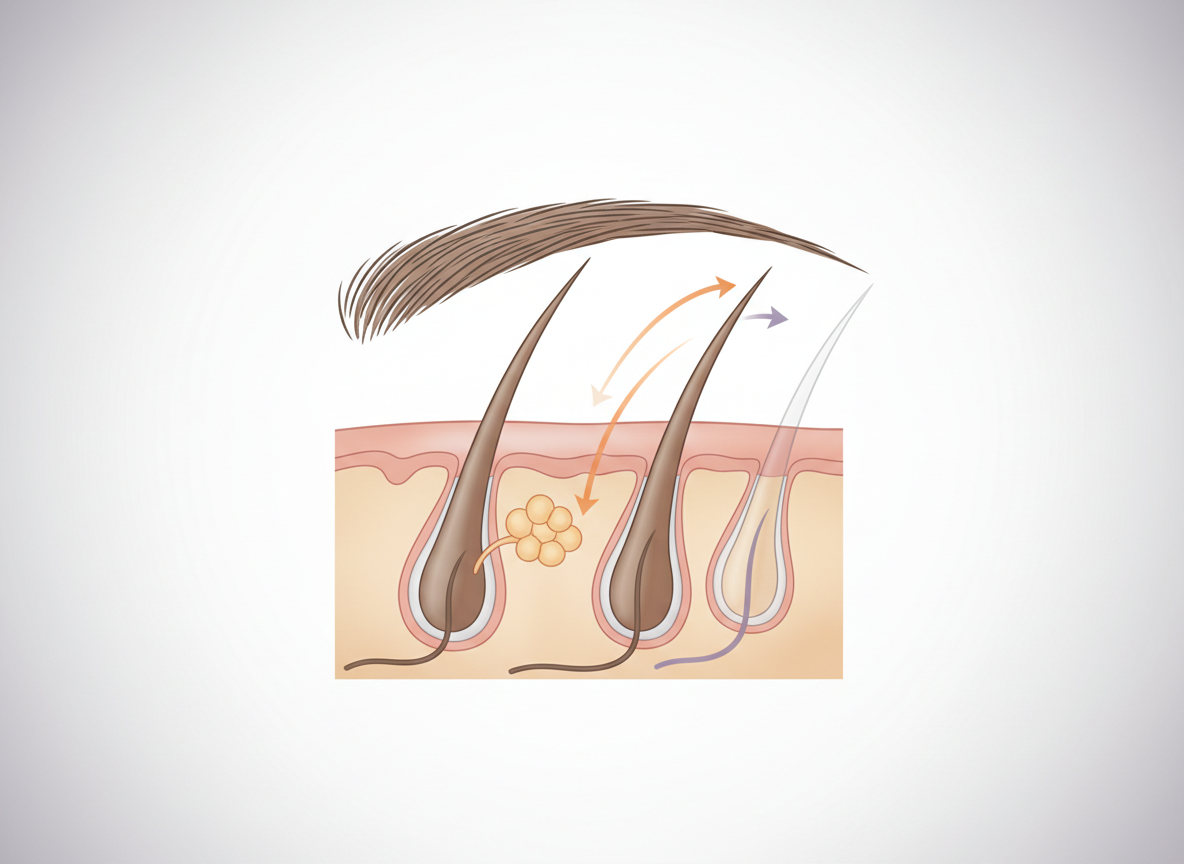
Each eyebrow hair follows the same three-stage cycle as scalp hair: a growing phase, a brief transitional phase, and a resting phase before it sheds. The difference is that brows have a much shorter growing phase, which keeps them short. Anything that cuts that phase shorter, or pushes follicles into resting early, leads to thinner brows.
Different causes hit different points in that cycle. A thyroid imbalance can slow growth across the brow, as the QJM case report describes. Plucking damages individual follicles directly. Autoimmune conditions attack the follicle itself. Understanding which mechanism is at play helps target treatment.
This also explains how minoxidil helps. As the dermatology literature notes, minoxidil extends the growing phase and supports blood flow to the follicle, encouraging finer resting hairs to grow back thicker and longer, supporting eyebrow hair growth over time. It’s the same principle that makes it useful on the scalp, applied gently to the brow.
Diagnosing the cause of eyebrow loss
Finding the cause usually starts with a conversation, not a test. A clinician or pharmacist will ask about your grooming history, how the thinning developed, your general health, and any other symptoms, then take a look at the brows and surrounding skin. As Cleveland Clinic advises, anyone with new or unexplained hair loss should get it checked.
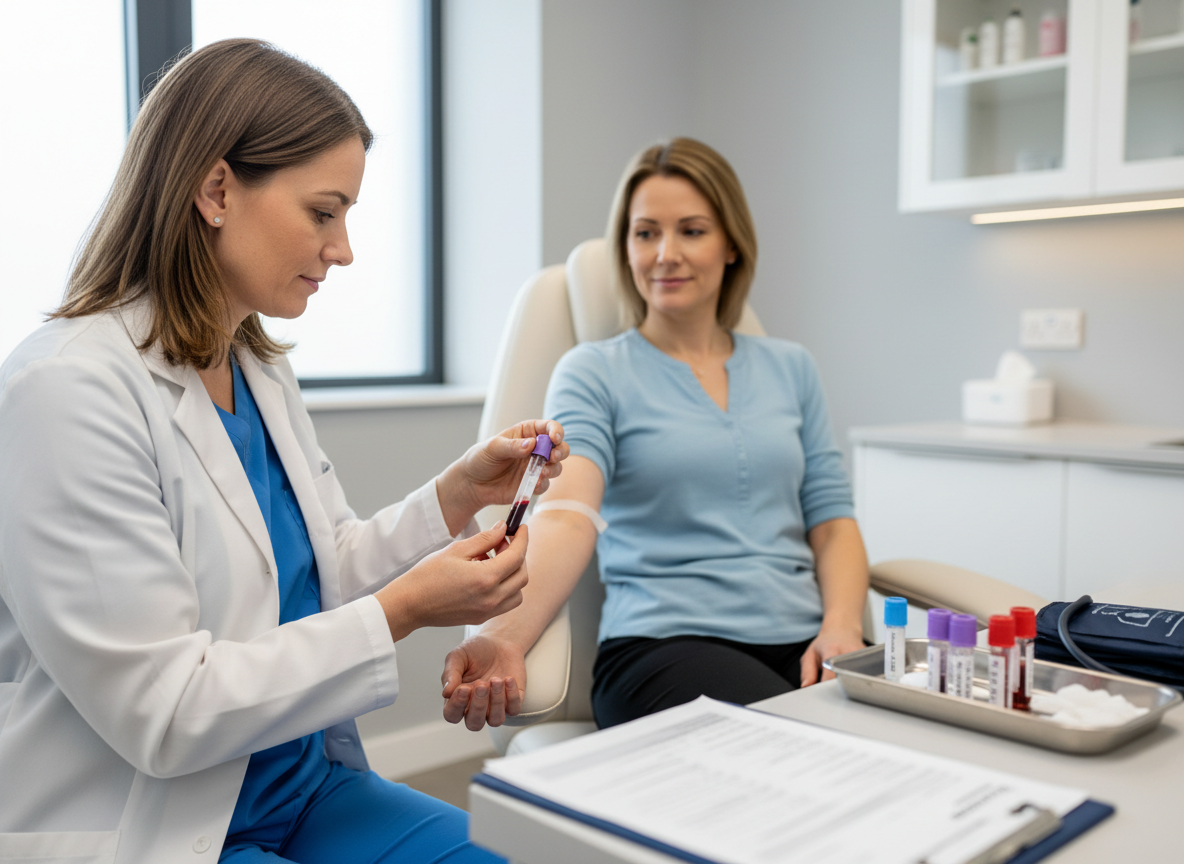
The pattern offers clues, and blood tests fill in the rest. Checking thyroid function and iron levels can reveal treatable causes, especially when the outer third is affected or there are other symptoms. As NICE Clinical Knowledge Summaries note, a thyroid blood test is straightforward and informative.
This is where Courier Pharmacy can support you directly. We can arrange the relevant blood panels, including thyroid function and ferritin, and we also offer TrichoTest, a pharmacogenetic test that helps personalise your hair plan. The aim is simple: understand the cause before choosing the treatment.
Supporting eyebrow hair growth: current treatments
The best approach is practical and personalised. As the comparative trial by Zaky and colleagues shows, topical treatments can improve eyebrow density, and the right plan often combines treating the cause with supporting eyebrow hair growth.
Treating the underlying cause
This comes first. If a thyroid problem, iron deficiency, or skin condition is driving the loss, addressing it can improve your brows on its own, as Cleveland Clinic notes. There’s little point chasing regrowth while the cause is still active.
Our compounded minoxidil 2% cream
Minoxidil is the best-evidenced topical option for eyebrows, and it’s the one we offer, compounded as a 2% cream. In a randomised, placebo-controlled split-face study, minoxidil 2% safely improved eyebrow hypotrichosis, and the comparative trial by Zaky and colleagues found it as effective as bimatoprost for boosting eyebrow density.
Why a compounded cream rather than an off-the-shelf solution? Because brows aren’t scalps. The liquids and foams made for the scalp are designed to spread, which is exactly what you don’t want next to your eyes. A cream stays where you put it, giving you far better control over a small, delicate area. Compounding also lets us make it fresh at the strength your prescriber chooses, and leave out ingredients that might irritate the thin skin around the brow.
Being freshly compounded, our minoxidil 2% cream has a 30-day shelf life from the date it’s made. So each pot is prepared for you and used within the month, which is also roughly how long one supply lasts with twice-daily use. It’s used off-label for eyebrows, so it’s supplied after a pharmacist assessment, and it needs several months of consistent use before you can judge it.

How to apply your minoxidil 2% cream
The routine is simple, and consistency matters more than quantity.
- Apply a small amount to clean, dry brows twice a day, morning and evening
- Use a clean fingertip or cotton bud, and work it gently into the brow area
- Keep it well away from your eyes, and don’t use it on broken or irritated skin
- Wash your hands thoroughly afterwards, so it doesn’t transfer elsewhere
- Store it as directed, and start a fresh pot each month, since it lasts 30 days
- Keep going. Brows grow slowly, so give it several months before judging results
Some people notice mild irritation, dryness, or itching, especially early on. Rarely, fine hair can appear on nearby skin if the cream spreads, which is why precise application and handwashing matter. If irritation persists, or you notice anything that concerns you, speak to a pharmacist. It isn’t suitable in pregnancy or breastfeeding.

Other topical options
Bimatoprost, a prostaglandin treatment better known for eyelashes, has also been shown to enhance eyebrows in the trial by Zaky and colleagues. It’s another option a prescriber may consider. Choosing between treatments comes down to your skin, your goals, and how you respond.
Compounded and personalised options
Standard products don’t suit everyone. Some people react to certain ingredients, or need a particular strength or base. This is where Courier Pharmacy’s personalised compounding comes in, letting us tailor a topical treatment around your skin and your needs.
Cosmetic and procedural options
While treatment works, or if regrowth is incomplete, cosmetic options help. As the dermatology literature notes, these range from pencils and tints to microblading and, in some cases, eyebrow transplant surgery. They sit alongside medical treatment rather than replacing it.
A note on supplements
Supplements like biotin are heavily marketed for hair, but the evidence is mixed. As the nutrition literature notes, they mainly help when there’s a genuine deficiency to correct. A pharmacist can help you test first and supplement only where it makes sense.
Patient experiences and challenges
If you’ve ever felt self-conscious filling in patchy brows every morning, you’ll know it’s about more than vanity. It’s one of the frustrations people share with us. Brows are central to how we recognise faces, including our own, so thinning can quietly chip away at confidence.
Many people also tell us they assumed nothing could be done, or didn’t realise their brow loss might be a health signal worth investigating. Others over-plucked for years and gave up hope of regrowth. As Cleveland Clinic stresses, new or unexplained eyebrow loss is worth getting checked, because the cause is often treatable.
Here’s what we want you to hear. You’re not being vain, and you’re not stuck with it. Eyebrow thinning is common, often reversible, and worth taking seriously. You’re the one living in your skin, and you get to decide what feeling like yourself looks like. Our job is to help you get there, with less guesswork.
Innovative and new treatments for eyebrow hair growth
Care for eyebrow hair growth keeps improving, and the most useful advances are about personalisation rather than gimmicks. As always, we’d weigh the evidence over the hype.
Genetic-led care is one shift worth knowing about. TrichoTest, which we offer at Courier Pharmacy, looks at genetic and lifestyle factors influencing hair loss to help tailor your plan. For brow loss linked to frontal fibrosing alopecia, the dermatology literature reports that low-dose oral minoxidil has helped some people, used under specialist guidance. Bimatoprost and platelet-rich plasma are also being explored.
At Courier Pharmacy, our role here is honest guidance. We’ll talk through what’s genuinely supported, what’s still emerging, and what’s simply marketing, so you can choose calmly rather than chase a trend.
Looking to the future: research and hope
The direction of travel is encouraging. Researchers are refining which treatments suit which causes, and developing better ways to personalise care from the start. As trials like the one by Zaky and colleagues add to the evidence, the options for supporting eyebrow hair growth keep growing.
There’s reason for steady optimism. Eyebrow thinning is common and increasingly treatable, and our understanding of its causes keeps improving. We won’t promise overnight transformation. What we will say is that, with the right plan, many people can support fuller brows and feel more themselves.
How Courier Pharmacy helps with eyebrow hair growth
We started Courier Pharmacy because too many people get one-size-fits-all care and a closed door. Eyebrow hair growth is a perfect example. Your brows, your biology, and your history are unique, so your plan should be too. That personalisation is the first of our four pillars, and it’s why we offer minoxidil 2% cream, compounded options, and TrichoTest.
The other three pillars carry it through. Guidance means our pharmacists help you understand your options, apply treatments safely, and avoid wasting money on things that won’t help. Trust means we’re a UK-regulated pharmacy, honest about what the evidence supports, and quick to suggest a blood test when your brows might be flagging something like a thyroid issue. Community means we show up for people, even when there’s nothing to buy.
That spirit has a face in Dr Ada Jex-Cori, the voice of our approach, whose message is simple: you’re not broken, and you deserve healthcare that fits your life. With thinning brows, that means finding the cause, choosing what genuinely helps, and supporting you along the way. Hair loss treatment that fits you, right down to your eyebrows.

Frequently asked questions about eyebrow hair growth
Why are my eyebrows thinning?
There are many possible reasons, from years of plucking to ageing, hormones, skin conditions, low iron, or a thyroid problem. As Cleveland Clinic explains, the pattern often hints at the cause. Because some causes are easily treatable, it’s worth getting new or unexplained eyebrow thinning checked rather than assuming it’s permanent.
Can losing the outer part of my eyebrows mean something medical?
It can. Loss of the outer third of the eyebrows, the part nearest your ears, is classically linked to an underactive thyroid, as a 2023 report in QJM describes. It isn’t proof on its own, but if you also feel tired, gain weight, or feel the cold, a thyroid blood test is worth doing. Courier Pharmacy can arrange one.
Does minoxidil work on eyebrows?
Yes, the evidence is encouraging. Randomised studies show topical minoxidil 2% safely improves eyebrow thickness and hair count, and one trial found it as effective as bimatoprost. We offer it as a freshly compounded 2% cream, applied twice a day, which stays put better than a scalp solution. It’s used off-label for brows, so it’s supplied after a pharmacist assessment, and it takes several months to work.
How do I use minoxidil 2% cream on my brows?
Apply a small amount to clean, dry eyebrows twice a day, morning and evening, using a clean fingertip or cotton bud. Keep it away from your eyes and broken skin, and wash your hands afterwards. Because it’s freshly compounded, each pot has a 30-day shelf life, so you start a fresh one monthly. Consistency matters more than quantity, and a pharmacist can talk you through it.
How long until I see results?
Eyebrows grow slowly, so patience is essential. Most studies run for around 16 weeks before judging results, and many people need several months of consistent use. If you stop, any gains tend to fade, so treatment usually needs to continue to maintain the effect.
Will my eyebrows grow back if I stop plucking?
Often, yes, but not always. Giving over-plucked brows a long rest can allow follicles to recover, though years of plucking can leave some follicles permanently inactive. If regrowth is slow or patchy, a treatment like minoxidil 2% cream may help support it.
Do supplements like biotin help eyebrow growth?
Only sometimes. As the nutrition literature notes, supplements mainly help when there’s a genuine deficiency, such as low iron, which is uncommon on a balanced diet. Biotin can also interfere with some blood tests. We’d rather test first and supplement only where it’s likely to make a difference.
Can Courier Pharmacy help if I’ve tried things that didn’t work?
Often, yes. We can review what you’ve tried, check for underlying causes with blood tests including thyroid and iron, use TrichoTest to personalise your plan, and offer minoxidil 2% cream or compounded options. It starts with a free chat with one of our pharmacists.
More than a condition: our community
Worrying about your appearance can feel isolating, especially when people assume it’s trivial. So we made a space where it isn’t. Every fortnight, we run free drop-in clinics and talks at Insomnia in Derby, from 10am to 12pm. No cost. No pressure. Just real support, honest answers, and people who understand.
How this content was created
Written by the Courier Pharmacy editorial team and reviewed by a GPhC-registered pharmacist. Grounded in the latest NHS, NICE, BNF and EMC guidance, peer-reviewed studies, and the real questions patients bring to our drop-in clinics in Derby.
By the Courier Pharmacy editorial team. Medically reviewed by a GPhC-registered pharmacist. Last reviewed: June 2026.
Important disclaimer
This page is for general information and education. It isn’t medical advice, and it isn’t a substitute for a consultation with a qualified healthcare professional. Minoxidil 2% cream is used off-label for eyebrows and may not be suitable for everyone, including during pregnancy or breastfeeding. New or unexplained eyebrow loss can occasionally signal an underlying condition, so it’s worth getting checked. Always speak to a prescriber or pharmacist before starting any treatment.

References
- National Health Service (2024) Hair loss. Available at: https://www.nhs.uk/conditions/hair-loss/ (Accessed: 22 June 2026).
- National Institute for Health and Care Excellence (no date) Hypothyroidism: Clinical Knowledge Summary. Available at: https://cks.nice.org.uk/topics/hypothyroidism/ (Accessed: 22 June 2026).
- National Institute for Health and Care Excellence (2023) Alopecia areata: Clinical Knowledge Summary. Available at: https://cks.nice.org.uk/topics/alopecia-areata/ (Accessed: 22 June 2026).
- Cleveland Clinic (2025) Madarosis. Available at: https://my.clevelandclinic.org/health/symptoms/24820-madarosis (Accessed: 22 June 2026).
- Taguchi, H. and Nishioka, H. (2023) ‘Eyebrow loss and the Queen Anne sign in hypothyroidism’, QJM: An International Journal of Medicine, 116(12), pp. 1029–1030. Available at: https://academic.oup.com/qjmed/article/116/12/1029/7224254 (Accessed: 22 June 2026).
- Zaky, M.S., Hashem, O.A., Mahfouz, S.M. and Elsaie, M.L. (2023) ‘Comparative study of the efficacy and safety of topical minoxidil 2% versus topical bimatoprost 0.01% versus topical bimatoprost 0.03% in treatment of eyebrow hypotrichosis: a randomized controlled trial’, Archives of Dermatological Research, doi:10.1007/s00403-023-02679-2. Available at: https://pmc.ncbi.nlm.nih.gov/articles/PMC10514173/ (Accessed: 22 June 2026).
- Minoxidil 2% lotion for eyebrow enhancement: a randomized, double-blind, placebo-controlled, split-face comparative study (2014), Journal of Dermatological Treatment. Available at: https://pubmed.ncbi.nlm.nih.gov/24471459/ (Accessed: 22 June 2026).
- Courier Pharmacy (2026) Comprehensive review of female hair loss: Pathophysiology, treatments, and emerging research. Available at: https://courierstaging.mystagingwebsite.com/comprehensive-review-of-female-hair-loss/ (Accessed: 22 June 2026).

BSc Pharmacy, Independent Prescriber, PgDip Endocrinology, MSc Endocrinology, PgDip Infectious Diseases
Superintendant Pharmacist, Independent Prescriber

BSc Pharmacy
Compounding Pharmacist

